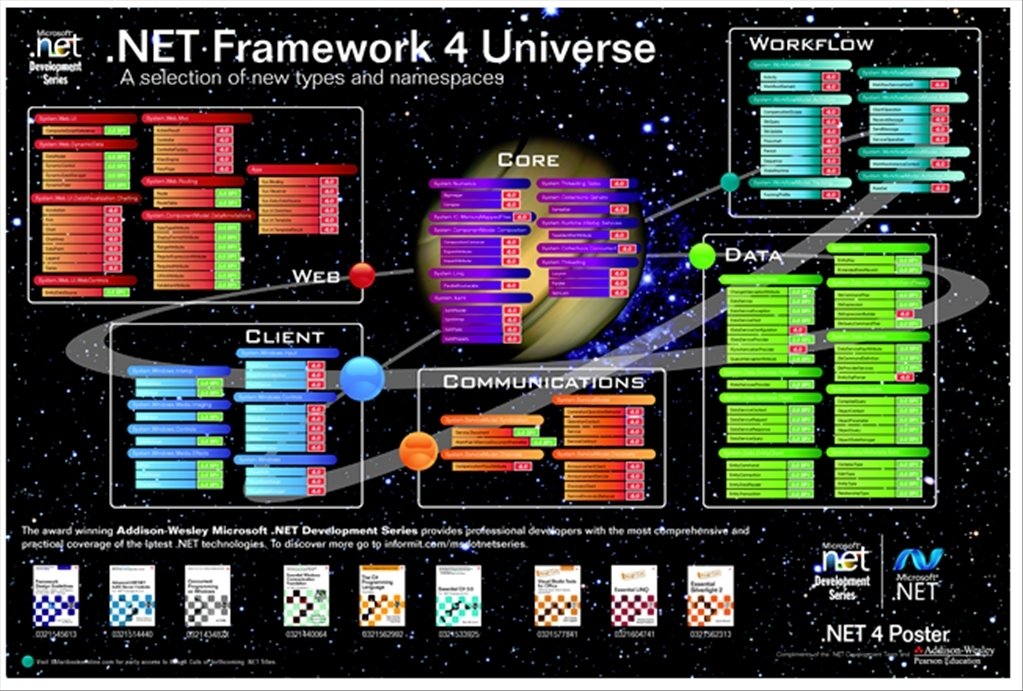
BENEFITS OF THE .NET FRAMEWORK

Some of the advantages offered by the .NET Framework
Consistent programming model: The .NET Framework provides a common object-oriented programming model across languages. This object model can be used in code to perform several tasks, such as reading from and writing to files, connecting to databases, and retrieving data.

Multi-platform applications: There are several versions of Windows most of which run on x86 CPUs. Some versions, such as Windows CE and 64-bit Windows, run on non-x86 CPUs as well. A .NET application can execute on any architecture that is supported by the CLR. In future, a CLR version could even be built for non-Windows platforms.

Multi-language integration: .NET allows multiple languages to be integrated. For example, it is possible to create a class in Visual C# that derives from a class implemented in Visual Basic. To enable objects to interact with each other regardless of the language used to develop them, a set of language features has been defined in Common Language Specification (CLS). This specification includes the basic language features required by many applications. The CLS enhances language interoperability. The CLS also establishes certain requirements, which help you to determine whether your managed code conforms to the CLS. Most of the classes defined in the .NET Framework class library are CLS-compliant.

Automatic resource management: While creating an application, a programmer may be required to write code for managing resources such as files, memory, network connections, and database resources. If a programmer does not free these resources, the application may not execute properly. The CLR automatically tracks resource usage and relieves a programmer of the task of manual resource management.

Ease of deployment: One of the goals of the .NET Framework is to simplify application deployment. .NET applications can be deployed simply by copying files to the target computer. Deployment of components has also been simplified. Till now, Microsoft’s Component Object Model (COM) has been used for creating components. COM suffers from various problems relating to deployment. For example, every COM component needs to be registered before it can be used in an application. Moreover, two versions of a component cannot run side-by-side. In such a case, if you install a new application that installs the newer version of the component, the newly installed application may function normally. However, the existing applications that depend on the earlier version of the component may stop functioning.

As against this, the .NET Framework provides zero-impact deployment. Installation of new applications or components does not have an adverse effect on the existing applications. In the .NET Framework, applications are deployed in the form of assemblies. An assembly stores metadata. Therefore, registry entries are not required for storing information about components and applications. In addition, assemblies also store information about the versions of components used by an application. Therefore, the problems relating to versioning are also eliminated in the .NET Framework.

.NET Framework versions available

.NET Framework 1.0

The first version of the .NET Framework was released in January of the year 2002.

.NET Framework 1.1

Version 1.1 is the first major revision of the Framework; including the following changes:
  • Built-in support for mobile ASP.NET controls. Previously available as an add-on for .NET Framework 1.0, now part of the framework.
  • Security changes - enable Windows Forms assemblies to execute in a semi-trusted manner from the Internet, and enable code access security in ASP.NET applications.
  • Built-in support for ODBC and Oracle databases. Previously available as an add-on for .NET Framework 1.0, now part of the framework.
  • .NET Compact Framework - A version of .NET Framework for mobile devices; such as Microsoft Windows CE
  • IPv6 support.

.NET Framework 2.0

Introducing a major change in the Framework, the version 2.0 has the following changes:
  • New API features
  • Programming support for x86_64 processor architechtures.

.NET Framework 3.0

The new version of .NET Framework, previously called WinFX is a fundemental part of Windows Vista and is available on Windows XP.
The Framework contains four major new features:
  • WPF - Windows Presentation Foundation, codenamed Avalon
  • WCF - Windows Communication Foundation, codenamed Indigo
  • WF - Windows Workflow Foundation
  • WCS - Windows CardSpace, codenamed InfoCard

.NET Framework 3.5

The 3.5 version of the .NET Framework is the release of .NET Framework after version 3, adding a few new features and improvements, such as improvements to the C# language (3.0 specification), and VB.NET compiler.

.NET Framework 4.0

.NET 4.0 is the current release of the .NET framework, launched alongside Visual Studio 2010, including new features, such as language features for Visual Basic .NET and C#, and improvements, such as Parallel Extensions to improve support for parallel computing.

INTRODUCING THE .NET FRAMEWORK

Microsoft has introduced the .NET infrastructure with the intention of bridging the gap in interoperability between applications. It aims at integrating various programming languages and services. It is designed to make significant improvements in code reuse, code specialization, resource management, multi-language development, security, deployment, and administration. It consists of all the technologies that help in creating and running robust, scalable, and distributed applications.

INTRODUCING .NET

Applications are developed to support organizations in their business operations. Applications accept input, process the data based on business rules, and provide data as output. The functions performed by an application can be divided into three categories: user services, business services, and data services. Each category is implemented as a layer in an application. The user services layer constitutes the frontend of a solution. It is also called a presentation layer because it provides an interactive user interface.
The business services layer controls the enforcement of business rules on the data of an organization. Business rules encompass those practices and activities that define the behavior of an organization. For example, an organization may have decided that the credit limit of clients cannot exceed $200000. The business services layer performs validations pertaining to business rules. It ensures that the back-end does not receive incorrect data. The data services layer comprises the data and the functions for manipulating this data. These three layers form the base of the models or architectures used in application development.

Applications may vary from single-tier desktop applications (applications that follow the single-tier architecture) to multi-tier applications (applications that follow the two- , three-, or n-tier architecture).

Single-Tier Architecture
In the case of the single-tier architecture, a single executable file handles all functions relating to the user, business, and data service layers. Such an application is also called a monolithic application. Some of the very early COBOL programs performing extremely mission-critical operations fall under this category.

                                                     Monolithic Application

          |                       |                    |                             |                    |                       |
          | User Services |                    | Business Services |                    | Data Services |
          |                       |                    |                             |                    |                       |

Two-Tier Architecture
The two-tier architecture divides an application into the following two components:
  1. Client: Implements the user interface
  2. Server: Stores data
In the two-tier architecture, the business services layer may be implemented in one of the following ways:
  • By using fat client
  • By using fat server
  • By dividing the business services between the user services and the data services
In the case of fat clients, the business services layer is combined with the user services layer. Clients execute the presentation logic and enforce business rules. The server stores data and processes transactions. The fat client model is used when the server is overloaded with transaction processing activities and is not equipped to process business logic.

In a two-tier architecture with a fat server, the business services layer is combined with the data services layer. As business services are stored on the server, most of the processing takes place on the server.

You can also implement a two-tier model in which the business services are distributed between the user and data services. In this case, the processing of the business logic is distributed between the user and data services.

Three-Tier Architecture
In three-tier architecture, all the three service layers reside separately, either on the same machine or on different machines. The user interface interacts with the business logic. The business logic validates the data sent by the interfaces and forwards it to the database if it conforms to the requirements. The front-end only interacts with business logic, which, in turn, interacts with the database.

                   Client                               Business Logic                            Data Store
          |                       |                    |                             |                    |                       |
          | User Services |                    | Business Services |                    | Data Services |
          |                       |                    |                             |                    |                       |

N-Tier Architecture
An n-tier application architecture is not restricted to a specific number of layers. It has multiple servers handling business services. The advantages of n-tier architecture are:
  • Extensibility
  • Resilience to change
  • Maintainability
  • Scalability
These applications serve organization-specific requirements. Therefore, most modern enterprise applications are based on the n-tier application architecture.

Advertise


If you want to advertise on this site, please contact me. Free!

Visual Basic .NET Training


I will provide training on Visual Basic. NET for those of you who need it. Please provide the place and contact me to provide training.

About Us

This site will provide a variety of sources that you may need in learning Visual Basic .NET. I will give the best to fellow visitors of this site. Hopefully, with the existence of these sites can be useful for myself and for all people who need them. Thank those of you who have visited this site. Enjoy!

Privacy Policy

www.visualbasicdotnet.co.cc has established this Privacy Policy to explain how it protects and manages the personal information that it collects from you (the customer) online.

If you require any more information or have any questions about our privacy policy, please feel free to contact us by email at diehard5866@gmail.com.

At www.visualbasicdotnet.co.cc, the privacy of our visitors is of extreme importance to us. This privacy policy document outlines the types of personal information is received and collected by www.visualbasicdotnet.co.cc and how it is used. 

Log Files
Like many other Web sites, www.visualbasicdotnet.co.cc makes use of log files. The information inside the log files includes internet protocol ( IP ) addresses, type of browser, Internet Service Provider ( ISP ), date/time stamp, referring/exit pages, and number of clicks to analyze trends, administer the site, track user's movement around the site, and gather demographic information. IP addresses, and other such information are not linked to any information that is personally identifiable. 

Cookies and Web Beacons
www.visualbasicdotnet.co.cc does use cookies to store information about visitors preferences, record user-specific information on which pages the user access or visit, customize Web page content based on visitors browser type or other information that the visitor sends via their browser. 

DoubleClick DART Cookie

.:: Google, as a third party vendor, uses cookies to serve ads on www.visualbasicdotnet.co.cc.

.:: Google's use of the DART cookie enables it to serve ads to your users based on their visit to www.visualbasicdotnet.co.cc and other sites on the Internet.

.:: Users may opt out of the use of the DART cookie by visiting the Google ad and content network privacy policy at the following URL - http://www.google.com/privacy_ads.html
Some of our advertising partners may use cookies and web beacons on our site. Our advertising partners include Google Adsense and Amazon.

These third-party ad servers or ad networks use technology to the advertisements and links that appear on www.visualbasicdotnet.co.cc send directly to your browsers. They automatically receive your IP address when this occurs. Other technologies ( such as cookies, JavaScript, or Web Beacons ) may also be used by the third-party ad networks to measure the effectiveness of their advertisements and / or to personalize the advertising content that you see.

www.visualbasicdotnet.co.cc has no access to or control over these cookies that are used by third-party advertisers.

You should consult the respective privacy policies of these third-party ad servers for more detailed information on their practices as well as for instructions about how to opt-out of certain practices. www.visualbasicdotnet.co.cc privacy policy does not apply to, and we cannot control the activities of, such other advertisers or web sites.

If you wish to disable cookies, you may do so through your individual browser options. More detailed information about cookie management with specific web browsers can be found at the browsers' respective websites.

Contact Us

087813445866
diehard5866@gmail.com
Jl. Gajah No.57 Pulo Ara Bireuen 24251
 

About the Author

My name is Jakfar Zakaria. My friends call me Jakfar. I have lived such a tiring journey, about my education and others. Four years ago, I explore the computer network specializes in Linux Technology. And now I steeped about computer programming. I have little ability in computer programming, I focus on Visual Basic .NET programming language and PHP programming language. It takes a big sacrifice in studying it all, and my teacher is Google! Yups, Google! Google is a good teacher for me.

JOIN THE COMMUNITY!

TAKE A BREAK